
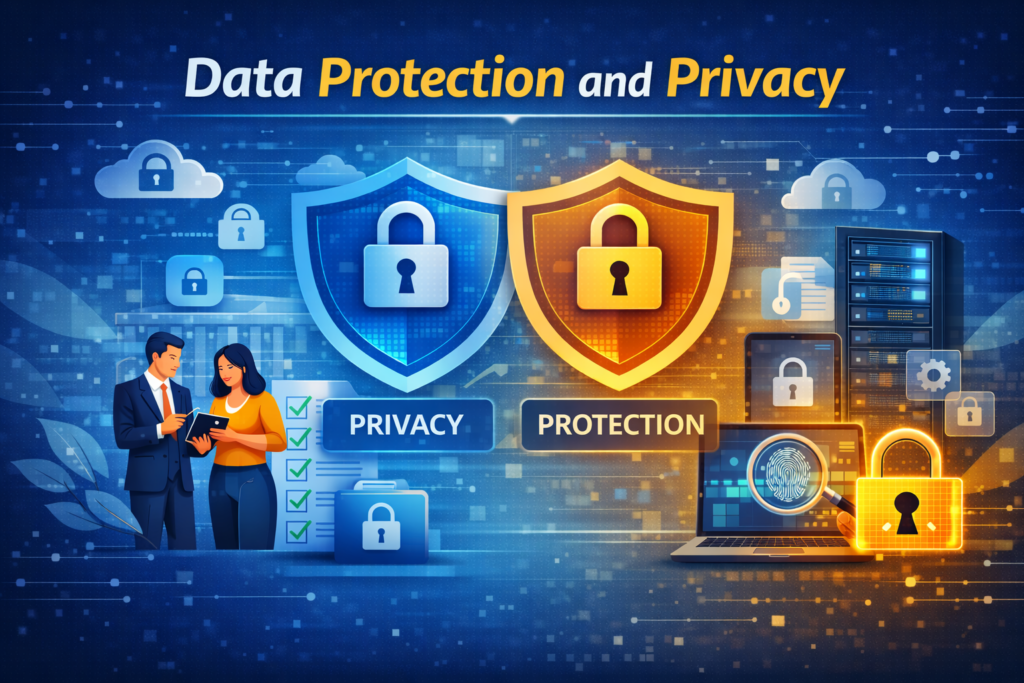
Quick Answer: Data protection and privacy refers to the practices, technologies, and legal frameworks that govern how personal data is collected, used, stored, and secured. Data privacy ensures individuals have rights and control over their information. Data protection ensures that information is secured against unauthorized access, breaches, and misuse. Together, they are the foundation of responsible data governance for any modern business.
Data protection and privacy has become one of the most critical operational and legal priorities for businesses in the digital age. Organizations today collect, process, and store vast volumes of personal and sensitive data — and without proper safeguards, that data becomes vulnerable to misuse, breaches, and regulatory penalties that can reach crores of rupees.
This guide covers everything businesses need to know: what data protection and privacy means, why it matters, the key principles, legal requirements, technical controls, and how to build a compliant, resilient data governance program.
What’s in this guide:
- What is data protection and privacy
- Key principles and why they matter
- Regulatory landscape — GDPR, DPDP Act, and more
- Technical security controls required
- Data lifecycle, governance, and cloud environments
- Incident response and breach management
- How Infodot helps organizations implement both
What is Data Protection and Privacy?
Data protection and privacy are two distinct but deeply interconnected disciplines. Understanding how they differ — and how they work together — is the starting point for any compliance or security program.
Data Privacy
Governs how personal data is collected, used, and shared. Focuses on individual rights, informed consent, transparency, and purpose limitation. The “what” and “why” of data handling.
Data Protection
Governs how data is secured against unauthorized access, breaches, and loss. Focuses on encryption, access controls, monitoring, and incident response. The “how” of keeping data safe.
For a detailed comparison, read our guide on data privacy vs data protection — key differences explained.
Why Data Protection and Privacy Matters for Businesses
The stakes have never been higher. India’s DPDP Act carries penalties of up to ₹250 crore. GDPR fines have exceeded €1 billion globally. Beyond financial penalties, a single data breach can permanently damage customer trust and brand reputation. Understanding how DPDP intersects with cybersecurity helps frame why data protection and privacy is a board-level priority, not just an IT concern.
- Prevents data breaches that lead to financial loss and significant reputational damage
- Ensures compliance with regulations — GDPR, DPDP Act, IT Act 2000, and sector-specific laws
- Builds customer trust by demonstrating responsible handling of personal and sensitive information
- Enhances business continuity by minimizing disruptions caused by cyber incidents or breaches
- Provides competitive advantage by positioning the organization as secure and trustworthy
Key Principles of Data Protection and Privacy
All major data protection and privacy frameworks — GDPR, DPDP Act, and others — are built on a common set of foundational principles. These principles are legally enforceable, not just aspirational guidelines. Our comprehensive guide on what is data privacy and protection explores these principles in full depth.
- Data Minimization: Collect only the data actually necessary for the defined business purpose
- Purpose Limitation: Use data only for the reason it was collected — additional use requires fresh consent
- Transparency: Clearly communicate to users how their data is collected, used, and shared
- Accountability: Organizations must demonstrate compliance — not just claim it
- Security: Implement technical and organizational measures to protect data from unauthorized access
- Accuracy: Keep data correct and up to date throughout its lifecycle
Types of Data Covered
Data protection and privacy obligations apply differently depending on the type of data involved. Understanding data categories helps organizations apply the right level of controls and governance.
- Personal Data: Names, contact details, and identifiers that can identify individuals directly or indirectly
- Sensitive Data: Financial, health, and biometric information requiring higher levels of protection
- Business Data: Operational and strategic information critical for organizational performance
- Public Data: Openly available information that still requires responsible handling in certain contexts
- Classified Data: Restricted-access information with significant impact if exposed
Regulatory Landscape
Data protection and privacy is governed by a growing body of legislation across India and globally. For Indian businesses, the DPDP Act is the primary framework, supplemented by CERT-In cybersecurity compliance requirements. Understanding how these laws intersect is covered in our guide on data protection and privacy in cyber law.
| Regulation | Jurisdiction | Key Requirement |
|---|---|---|
| DPDP Act 2023 | India | Consent, data principal rights, breach notification, penalties up to ₹250 crore |
| IT Act 2000 | India | Cybercrime prevention, digital transactions, data protection obligations |
| GDPR | European Union | Consent, user rights, accountability — penalties up to €20M or 4% of global turnover |
| HIPAA | USA (Healthcare) | Healthcare data confidentiality, integrity, and security requirements |
| CCPA | California, USA | Consumer rights over personal data usage, sale, and disclosure |
Data Lifecycle Management
Data protection and privacy obligations apply at every stage of the data lifecycle — from collection through to deletion. Each stage requires specific controls to ensure security and compliance throughout.
- Collection: Must follow consent-based practices with full transparency and regulatory compliance
- Storage: Requires secure systems with encryption and access controls to prevent unauthorized usage
- Processing: Must align with defined purposes and follow compliance guidelines consistently
- Sharing: Should be controlled and documented to ensure accountability and secure transfer
- Deletion: Ensures removal of unnecessary data, reducing exposure and improving compliance posture
Technical Security Controls
Data protection and privacy requires a layered set of technical security controls. Even if one control fails, others continue to protect the data. Our Information Security (InfoSec) services help organizations implement these controls comprehensively and in full alignment with regulatory requirements.
- Encryption: Ensures data remains unreadable during storage and transmission across systems
- Access Controls: Restrict unauthorized users and enforce role-based permissions for secure handling
- Network Security: Protects systems from external threats using firewalls and intrusion detection
- Endpoint Protection: Secures devices accessing data, preventing malware and unauthorized activities
- Security Audits: Validate control effectiveness and identify gaps — supported by IT audit and compliance services
Identity and Access Management
Controlling who can access data is one of the most fundamental requirements of data protection and privacy. Strong identity governance ensures only the right people access the right data at the right time, significantly reducing both insider and external threat risks.
- Multi-Factor Authentication: Adds extra security layers beyond standard password access
- Least Privilege Access: Users have only the permissions they actually need — no more
- Role-Based Access: Assigns permissions based on job roles, improving governance and simplifying management
- Access Reviews: Ensures permissions remain appropriate as organizational roles change
- Identity Monitoring: Tracks login activities and detects suspicious behavior in real time
Role of Technology in Data Protection and Privacy
Technology is the engine that makes data protection and privacy practical at scale. Remote Monitoring and Management (RMM) services deliver the continuous visibility organizations need to detect threats and respond before data is compromised. Keeping systems current through patch management services closes the vulnerabilities that attackers most commonly exploit to gain unauthorized access to personal data.
- Encryption Tools: Protect data during storage and transmission, ensuring confidentiality across systems
- Monitoring Systems: Detect suspicious activities and provide real-time alerts for potential threats
- Access Management Tools: Control permissions ensuring only authorized users access sensitive data
- AI Analytics: Identify anomalies and predict risks, enhancing proactive protection strategies
- Automation: Improves compliance processes by reducing manual effort and ensuring consistency
Consent Management
Consent is central to data privacy — and it has direct technical implications for how data systems are built and operated. Understanding how consent managers work under the DPDP Act is essential for Indian businesses building compliant data collection and processing pipelines.
- Requires informed, specific, and revocable user consent before any data processing begins
- Systems must record and store consent for audit and regulatory verification purposes
- Users must be able to withdraw consent at any time through simple, accessible mechanisms
- Consent records serve as primary evidence of compliance during regulatory audits
Incident Response and Breach Management
No data protection program is complete without a structured incident response capability. Understanding cyber incident reporting timelines and regulatory expectations helps organizations meet mandatory breach notification obligations under the DPDP Act and other cyber laws.
- Incident Response Plans: Define clear steps for detecting, containing, and recovering from breaches
- Breach Notification: Timely communication with authorities and affected individuals is legally required
- Forensic Analysis: Identifies root causes and helps prevent recurrence of similar incidents
- Incident Logs: Track all activities during breaches, supporting investigations and regulatory reporting
- Post-Incident Reviews: Improve processes and strengthen overall data protection continuously
Data Governance Framework
Data protection and privacy depends on a strong governance framework that defines policies, roles, and responsibilities across the organization. The role of the Data Protection Officer (DPO) in cybersecurity governance is increasingly central to this framework — DPOs bridge legal compliance and technical implementation for personal data.
- Governance Policies: Define rules and guidelines for managing data across organizational processes
- Data Ownership: Assigns responsibility for managing data and ensuring accountability
- Compliance Monitoring: Ensures adherence to regulations through regular reviews and assessments
- Risk Management: Identifies threats and implements mitigation strategies proactively
- Governance Committees: Oversee initiatives ensuring alignment with business and regulatory objectives
Data Privacy in Cloud Environments
As organizations migrate to cloud infrastructure, data protection and privacy obligations follow the data — regardless of where it is stored. Our cloud backup and storage solutions ensure personal data stored in cloud environments remains protected, compliant, and fully recoverable.
- Shared Responsibility: Defines security roles between cloud providers and organizations
- Cloud Encryption: Protects data both in transit and at rest within cloud environments
- Access Controls: Restrict unauthorized users from accessing cloud-based systems and data
- Monitoring Tools: Track cloud activities and detect anomalies indicating security risks
- Compliance Validation: Ensures cloud services meet regulatory standards consistently
Employee Awareness and Training
Human error remains one of the leading causes of data breaches globally. A technically strong data protection program can still be undermined by untrained employees. Reviewing how continuous IT governance strengthens long-term compliance underlines why ongoing awareness is as important as technical controls.
- Regular training educates employees about data protection practices and emerging cyber threats
- Phishing simulations test awareness and improve ability to detect suspicious communications
- Policy awareness ensures employees understand their specific responsibilities for data handling
- Security culture encourages proactive behavior reducing risks from human error and negligence
- Continuous learning keeps staff updated on new threats and evolving regulatory requirements
Risks of Poor Data Protection and Privacy
The consequences of failing to implement adequate data protection and privacy practices are severe and far-reaching. Organizations must understand these risks to prioritize investment in the right areas.
- Data Breaches: Expose sensitive information leading to financial losses and reputational damage
- Regulatory Penalties: Non-compliance can result in penalties reaching ₹250 crore under the DPDP Act
- Loss of Customer Trust: Trust is difficult to rebuild once lost — data breaches have lasting brand impact
- Operational Disruption: Systems compromised during breaches can halt operations for days or weeks
- Increased Cyber Exposure: Weak data governance creates exploitable vulnerabilities across the organization
How Infodot Helps Achieve Data Protection and Privacy
Infodot helps organizations implement data protection and privacy through structured frameworks, security controls, and managed services tailored to regulatory requirements. Our managed IT support services ensure your organization has the technical infrastructure, governance support, and ongoing monitoring needed to protect personal data and maintain compliance across all applicable frameworks.
- Conducts data privacy assessments to identify gaps and recommend improvements aligned with regulations
- Implements security controls including encryption, monitoring, and access management across systems
- Develops compliance frameworks aligned with GDPR, DPDP Act, IT Act 2000, and other applicable laws
- Provides continuous monitoring and reporting for proactive risk management and operational visibility
- Supports incident response planning ensuring readiness and minimizing impact of potential data breaches
Conclusion
Data protection and privacy is not a compliance checkbox — it is a strategic imperative for every modern business. Organizations that genuinely invest in both privacy principles and protection controls gain trust, reduce risk, and build a foundation for sustainable growth in an increasingly data-driven and regulated world. The cost of non-compliance — financial, legal, and reputational — far outweighs the investment in getting it right from the start.
FAQs — Data Protection and Privacy
What is Data Protection and Privacy?
Data Protection and Privacy refers to safeguarding personal data while ensuring it is used responsibly. It combines security measures and privacy principles to protect sensitive information and maintain trust between organizations and individuals.
Why is Data Protection and Privacy important?
It helps prevent data breaches, ensures compliance with laws, builds customer trust, and protects organizations from financial and reputational risks associated with mishandling personal data.
Who should implement Data Protection and Privacy?
Any organization handling personal or sensitive data must implement Data Protection and Privacy practices, regardless of size, industry, or location.
What is personal data?
Personal data includes any information that can identify an individual, such as name, contact details, or digital identifiers.
What is data privacy?
Data privacy focuses on how personal data is collected, used, and shared responsibly with user consent.
What is data protection?
Data protection involves securing data through technical and organizational measures to prevent unauthorized access or misuse.
What is a data breach?
A data breach is an incident where sensitive data is accessed or exposed without authorization, leading to financial loss, legal penalties, and reputational damage.
What is consent in data privacy?
Consent is user permission to collect and process personal data for specific purposes. It must be informed, specific, and revocable at any time without negative consequences.
What is data encryption?
Encryption converts data into unreadable format to protect it from unauthorized access during storage and transmission across systems and networks.
What is access control?
Access control restricts data access to authorized users only, using authentication and role-based permissions to prevent misuse and unauthorized data exposure.
What is data encryption in Data Protection and Privacy?
Data encryption in Data Protection and Privacy is the process of converting data into unreadable format to prevent unauthorized access. It ensures sensitive information remains secure during storage and transmission across systems.
What is access control in Data Protection and Privacy?
Access control in Data Protection and Privacy ensures only authorized users can access specific data. It uses authentication and role-based permissions to prevent misuse and reduce risks of unauthorized data exposure.
What is monitoring in Data Protection and Privacy?
Monitoring in Data Protection and Privacy involves tracking data access and system activity. It helps detect suspicious behavior early, enabling quick response to potential threats and minimizing the impact of security incidents.
What is data governance in Data Protection and Privacy?
Data governance in Data Protection and Privacy refers to policies, processes, and responsibilities for managing data. It ensures consistency, accountability, and compliance with regulatory requirements across the organization.
What is a data breach in Data Protection and Privacy?
A data breach in Data Protection and Privacy is an incident where sensitive information is accessed or exposed without authorization. It can lead to financial loss, legal penalties, and serious reputational damage.
What is breach notification in Data Protection and Privacy?
Breach notification in Data Protection and Privacy requires organizations to inform authorities and affected individuals when a data breach occurs. This ensures transparency and allows timely actions to reduce potential harm.
What is data retention in Data Protection and Privacy?
Data retention in Data Protection and Privacy defines how long data is stored. Organizations must retain data only as necessary and securely delete it afterward to reduce exposure risks and maintain compliance.
What is data masking in Data Protection and Privacy?
Data masking in Data Protection and Privacy hides sensitive data while allowing safe usage for testing or operational purposes. It prevents exposure of actual values during processing activities.
What is the role of employees in Data Protection and Privacy?
Employees play a crucial role in Data Protection and Privacy. Proper training ensures they follow policies, avoid mistakes, and handle sensitive information responsibly, reducing risks from human error and negligence.
What is cloud security in Data Protection and Privacy?
Cloud security in Data Protection and Privacy ensures data stored in cloud systems is protected through encryption, access controls, and monitoring, while maintaining compliance with regulatory standards and data protection obligations.
What is risk assessment in Data Protection and Privacy?
Risk assessment in Data Protection and Privacy identifies potential threats to data and evaluates their impact. It helps organizations implement appropriate controls to mitigate risks effectively and prioritize security investments.
What is an audit trail in Data Protection and Privacy?
An audit trail in Data Protection and Privacy is a record of all data-related activities. It supports monitoring, investigations, and compliance verification by providing full transparency into system actions and data access.
What is a compliance framework in Data Protection and Privacy?
A compliance framework in Data Protection and Privacy is a structured approach to implementing policies and controls. It ensures organizations meet regulatory requirements — such as GDPR and the DPDP Act — consistently and effectively.
What is accountability in Data Protection and Privacy?
Accountability in Data Protection and Privacy means organizations are responsible for protecting data and demonstrating compliance through proper documentation, governance, and implementation of security measures across all operations.
What is the role of automation in Data Protection and Privacy?
Automation in Data Protection and Privacy helps manage compliance, monitoring, and reporting efficiently. It reduces manual errors and ensures consistent enforcement of policies and security controls at scale.
What is the data lifecycle in Data Protection and Privacy?
The data lifecycle in Data Protection and Privacy includes stages like collection, storage, usage, sharing, and deletion. Each stage requires specific controls to ensure data security and regulatory compliance throughout.
What is data minimization in Data Protection and Privacy?
Data minimization in Data Protection and Privacy means collecting only the data that is strictly necessary for the defined purpose. This reduces risk exposure and ensures better compliance with privacy regulations.
What is purpose limitation in Data Protection and Privacy?
Purpose limitation in Data Protection and Privacy ensures data is used only for the specific reason it was originally collected. Any additional usage requires fresh consent, preventing unauthorized data processing and misuse.
What is identity management in Data Protection and Privacy?
Identity management in Data Protection and Privacy controls user identities and access rights across systems. It ensures secure authentication and significantly reduces risks of unauthorized access to sensitive data and systems.
What is incident response in Data Protection and Privacy?
Incident response in Data Protection and Privacy is a structured plan to detect, contain, and recover from data breaches efficiently. It ensures quick action to minimize impact and supports mandatory regulatory reporting obligations.
What is the role of regulations in Data Protection and Privacy?
Regulations in Data Protection and Privacy define how data must be collected, processed, and secured. They ensure organizations follow enforceable standards to protect personal information and avoid penalties under laws like GDPR and the DPDP Act.
What is data classification in Data Protection and Privacy?
Data classification in Data Protection and Privacy categorizes data based on its sensitivity and risk level. This helps organizations apply appropriate security controls and ensures better, more targeted data management across all systems.
How does Data Protection and Privacy improve trust?
Data Protection and Privacy improves trust by ensuring secure, transparent, and ethical handling of personal data. Customers feel more confident sharing information with organizations that consistently demonstrate a strong commitment to privacy and security.
What is the future of Data Protection and Privacy?
The future of Data Protection and Privacy will involve stricter regulations, AI-driven security technologies, greater automation, and an increased focus on individual user rights as digital data volumes continue to grow rapidly across industries.
Why should businesses invest in Data Protection and Privacy?
Businesses should invest in Data Protection and Privacy to reduce legal risks, ensure regulatory compliance, build lasting customer trust, and support long-term sustainable growth in a data-driven economy where penalties for non-compliance continue to increase significantly.