
⏱️ IT downtime costs SMBs ₹80K/hr. Are you covered?

DPDP Compliance Services for Startups & Enterprises in India

Achieve fast, audit-ready compliance with India’s Digital Personal Data Protection Act using Infodot’s integrated cybersecurity and compliance framework.

Introduction

India’s Digital Personal Data Protection (DPDP) Act has made data privacy a board-level priority. Organizations handling personal data must now implement structured frameworks for consent, governance, and security. However, most businesses struggle with fragmented systems, lack of expertise, and unclear compliance paths.
Infodot simplifies DPDP compliance with a practical, execution-driven approach. We combine cybersecurity, IT operations, and compliance expertise to deliver fast, scalable, and audit-ready solutions tailored for startups and enterprises.

What is DPDP Compliance?

DPDP compliance refers to aligning your organization with India’s Digital Personal Data Protection Act. It ensures that personal data is collected, processed, stored, and shared in a lawful, secure, and transparent manner.


Key elements include:
  • Consent-driven data processing: Ensure personal data is collected and used only after obtaining clear user consent
  • Data protection and security controls: Implement safeguards like encryption and access controls to protect sensitive data effectively
  • User rights management (access, correction, deletion): Enable users to view, update, or delete their personal data easily
  • Data lifecycle governance: Manage data from collection to deletion with clear policies and structured processes
  • Breach detection and reporting: Identify data breaches quickly and report incidents to authorities and affected users promptly
Why DPDP Compliance Matters

Why DPDP Compliance Matters

DPDP compliance is not just about regulation. It directly impacts trust, risk, and growth.

  • Avoid heavy regulatory penalties: Ensure compliance with DPDP requirements to prevent fines, legal issues, and business disruptions
  • Build customer and partner trust: Demonstrate strong data protection practices to increase confidence among customers and business partners
  • Enable funding and enterprise deals: Meet compliance expectations required by investors and large enterprises for partnerships and contracts
  • Reduce cyber risk exposure: Implement security controls that minimize chances of breaches and data-related incidents
  • Strengthen governance and operations: Establish structured processes improving accountability, efficiency, and overall data management practices

Clients we work with for CERT-In Compliance

Happy customers? Check!

As our IT support team, Infodot is quite reliable. No matter the size of the issue, we know that when we call or email, we will get a response back from your team. Your commitment to customer service is highly appreciated. Infodot has helped solve a lot of day-to-day IT challenges that were previously creating bottlenecks for us.

Laxmy Nair

Operation Head

“As an early stage start-up, the engineering team was fully focussed on our cloud infrastructure and we lacked time and skill to manage office IT infrastructure. This created many bottlenecks for us – unreliable office internet connectivity, unnecessary expenditures due to lack of regular maintenance etc. Once Infodot took up the upkeep of our office IT infrastructure, we could immediately recognize the value they brought in. New internet connectivity architecture was proposed and implemented by Infodot first. It really helped solving our office internet connectivity issues and made our office network more secure. As a co-founder, I also would like to mention that they are accommodative and they understand an early stage start-up’s financial constraints. We are happy with their services and would definitely recommend them.”

Jinaraj P G

Co-Founder and CTO
Simplicontract logo

Infodot’s DPDP Compliance Framework

We follow a structured, outcome-focused approach:
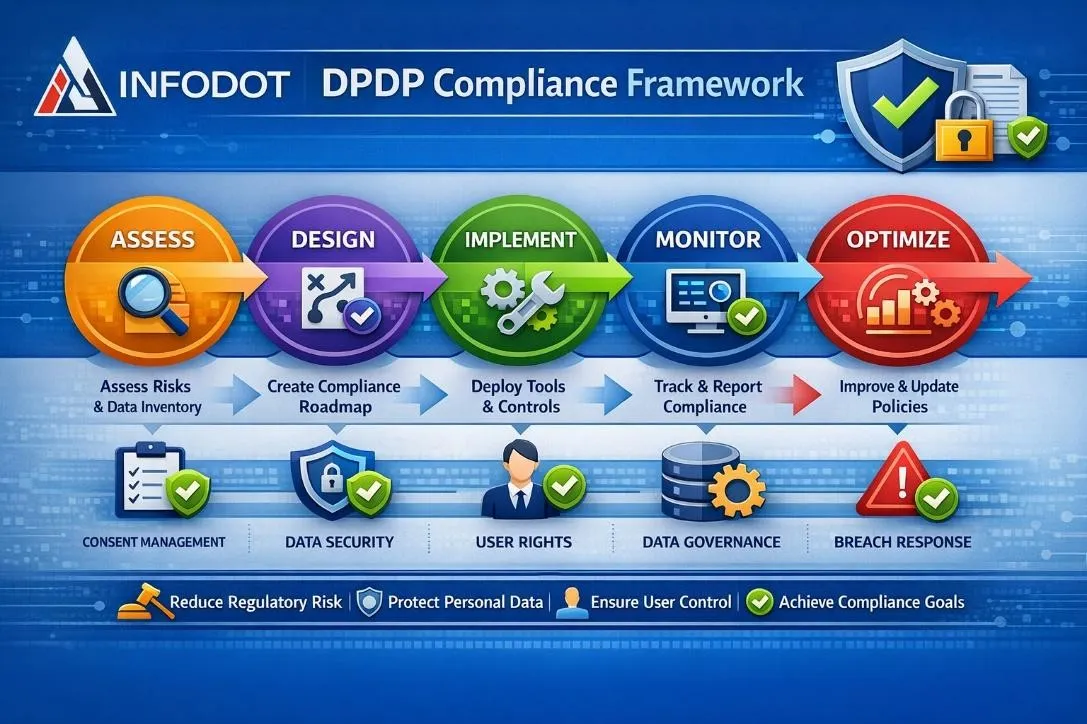
Assess

  • Current compliance maturity: Evaluate existing policies, controls, and systems to understand current DPDP compliance readiness level
  • Data inventory and risks: Identify personal data assets, map locations, and assess associated risks across systems
  • Tailored compliance roadmap: Create customized plan aligning business needs with DPDP regulatory requirements effectively
  • Policy and governance structure: Define policies, roles, and responsibilities ensuring structured data protection and accountability
  • Tools, controls, and workflows: Deploy compliance tools, security controls, and operational workflows across systems effectively
  • Security and consent systems: Implement mechanisms for data protection, access control, and user consent management
  • Continuous compliance tracking: Track compliance status in real time to identify gaps and risks proactively
  • Alerts and reporting: Generate alerts and reports for compliance issues, ensuring timely action and visibility
  • Ongoing improvements: Continuously refine processes, controls, and policies to strengthen compliance effectiveness over time
  • Audit readiness and updates: Maintain documentation and update systems to ensure readiness for audits and regulatory changes

Our DPDP Compliance Services

Identify what personal data you collect, where it resides, and how it flows.

  • Data inventory across systems: Identify and document all personal data stored across applications, databases, and business systems
  • Data classification and risk tagging: Categorize data by sensitivity and assign risk levels to apply appropriate protection controls
  • Data flow mapping: Track how data moves across systems, users, and third parties to ensure compliance
Read More

Ensure lawful data processing with clear and trackable consent mechanisms.

  • Consent capture and tracking: Collect user permissions clearly and maintain records of consent across all data processing activities
  • Consent withdrawal workflows: Enable users to easily revoke consent and update preferences across systems without delays
  • Audit-ready consent logs: Maintain detailed consent records ensuring transparency and readiness for compliance audits and verification
Read More

Establish structured policies and accountability.

  • Privacy policies and SOPs: Define clear rules and procedures for handling personal data across organization
  • Data retention and deletion policies: Establish timelines for storing and securely deleting personal data as required
  • Role-based ownership: Assign clear responsibility for data management to specific roles ensuring accountability and control
Read More

Integrate compliance with strong cybersecurity.

  • Endpoint and network security: Protect devices and networks from unauthorized access, malware, and potential cyber threats
  • Encryption and access control: Secure data using encryption while restricting access based on roles and permissions
  • Threat detection and monitoring: Continuously monitor systems to identify, detect, and respond to security threats proactively
Read More

Enable compliance with user rights under DPDP.

  • Access and correction workflows: Enable users to view, update, and correct their personal data easily and securely
  • Data deletion processes: Ensure personal data is permanently removed upon request or when no longer required
  • Grievance redressal mechanisms: Provide structured processes to handle user complaints and resolve data-related issues promptly
Read More

Ensure your partners are compliant.

  • Vendor assessments: Evaluate third-party providers for security, compliance, and data protection practices before engagement
  • Data processing agreements: Define contractual obligations ensuring vendors handle personal data securely and compliantly
  • Continuous vendor monitoring: Regularly track vendor performance and compliance to identify risks and ensure ongoing adherence
Read More

Stay prepared for audits and regulatory checks.

  • Compliance documentation: Maintain structured policies, procedures, and records demonstrating adherence to data protection regulations
  • Audit trails and logs: Record all data access and changes to ensure transparency and accountability across systems
  • Internal and external audit support: Assist with audits by preparing documentation, evidence, and ensuring compliance readiness
Read More

Be ready to respond to data breaches.

  • Incident response planning: Develop structured plans to identify, respond, and recover from data security incidents effectively
  • Breach detection and containment: Monitor systems to detect breaches quickly and limit impact through immediate containment actions
  • Regulatory reporting support: Assist in timely reporting of breaches to authorities and affected users as required
Read More

Get expert compliance oversight without full-time hiring.

  • Compliance governance: Establish structured policies, roles, and controls ensuring consistent data protection and regulatory adherence
  • Risk advisory: Identify potential compliance and security risks, providing strategies to mitigate and manage them effectively
  • Regulatory coordination: Liaise with authorities, manage reporting requirements, and ensure alignment with evolving regulatory expectations consistently
Read More

Why Choose Infodot

  • End-to-end DPDP compliance ownership: Complete responsibility from assessment to implementation, monitoring, and continuous compliance management across organization
  • Strong cybersecurity + compliance integration: Combines security controls with compliance frameworks to ensure robust protection and regulatory alignment
  • Tailored solutions for startups and enterprises: Custom compliance frameworks designed to match business size, complexity, and growth requirements
  • Faster implementation timelines: Accelerated deployment approach ensures quicker compliance readiness without compromising accuracy and effectiveness
  • Dedicated compliance and security experts: Experienced professionals provide hands-on guidance, implementation support, and ongoing compliance expertise
  • Continuous monitoring and advisory support: Ongoing tracking, updates, and expert advice ensure compliance remains consistent and up to date
  • Competitive pricing model: Cost-effective services delivering high value without the premium pricing of traditional consulting firms
  • Proven experience in privacy and cyber risk: Strong track record in managing data protection, cybersecurity risks, and regulatory compliance successfully
Businessman with a big lock standing in front of an open laptop and documents.

All Services from Infodot

Infodot provides a comprehensive range of IT services, including co-managed support, cybersecurity, cloud solutions, and IT consultancy, designed to optimize your business operations.

Co managed IT Support & Services approach where a business organisation shares its responsibilities to
Comprehensive IT management services to ensure your business systems run smoothly and efficiently.
Automate and manage software updates to protect systems from vulnerabilities and maintain performance.
Ensure your IT infrastructure aligns with industry standards and regulatory requirements through audits and compliance
Secure and reliable data backup solutions, both in the cloud and on-site, to safeguard your
Advanced protection for your networks, safeguarding against cyber threats, malware, and unauthorized access.
Expert advice and strategies to optimize your IT infrastructure and align technology with your business
Seamless migration services for cloud platforms, email, and servers, ensuring minimal disruption and maximum efficiency.
Responsive IT support to resolve technical issues, ensuring smooth operations and minimizing downtime.
Monitor, manage, and support your IT systems remotely to ensure optimal performance and reliability.
Flexible and scalable IT support tailored to adapt to your business needs, accessible anytime, anywhere.

CERT In Cybersecurity Compliance Services for MSMEs 🚨 URGENT: MSME Cybersecurity Compliance Now Mandatory Effective
Microsoft Windows 10 reaches its end of support on October 14, 2025, leaving over 1
Information Security Services (InfoSec Services) encompass the frameworks, technologies, and processes
Security Management as a Service (SECaaS) is a cloud-delivered approach to managing an organization’s
Infodot delivers SEBI cybersecurity framework compliance for AIF and VC funds, covering governance, cloud controls,
Looking for a trusted managed IT service provider in Chennai? Infodot delivers 24/7 proactive IT
Looking for a trusted managed IT service provider in Delhi NCR? Infodot delivers 24/7 proactive
Looking for a trusted managed IT service provider in Mumbai? Infodot delivers 24/7 proactive IT
Looking for a trusted managed IT service provider in Pune? Infodot delivers 24/7 proactive IT

Get Started Today

DPDP compliance is not a checkbox. It is a business enabler.

Start your journey with Infodot today.

  • Get a free compliance assessment 
  • Identify gaps in your current systems 
  • Receive a clear, actionable roadmap 

Emergency Hotline: Available 24/7 for incident response

Here are FAQs about CERT-in compliance

What is DPDP compliance?

DPDP compliance ensures your organization follows India’s data protection law by managing personal data securely, lawfully, and transparently, while enabling user rights and maintaining accountability.

It helps avoid penalties, builds customer trust, reduces cyber risks, and enables business growth through secure and compliant data practices.

It can take a few weeks for basic setups and several months for full implementation depending on complexity.

Yes, startups handling user data must comply to avoid risks, build trust, and support growth.

Costs vary based on size and scope, typically ranging from ₹50,000 to ₹10+ lakhs.

A Data Fiduciary is an organization or entity that determines the purpose and means of processing personal data. It is responsible for ensuring compliance, protecting data, and respecting user rights under the DPDP Act.

A Data Principal is the individual whose personal data is being processed. They have rights such as accessing, correcting, deleting their data, and withdrawing consent at any time.

Key requirements include obtaining valid consent, implementing security controls, enabling user rights, maintaining data governance, ensuring breach reporting, and keeping audit-ready documentation across all data handling processes.

Consent management involves collecting, storing, and managing user permissions for data processing. It ensures transparency and allows users to control how their personal data is used.

Data mapping identifies where personal data is stored and how it flows across systems. It helps organizations implement controls, reduce risks, and ensure compliance with data protection regulations.

A DPO oversees compliance, manages risks, handles user grievances, and ensures that the organization follows data protection laws effectively and consistently.

Yes, any business handling personal data must comply, regardless of size. Small businesses benefit from early compliance by reducing risks and building customer trust.

Non-compliance can lead to penalties, reputational damage, legal issues, and loss of customer trust. It can also impact business growth and partnerships.

Data minimization means collecting only the data necessary for a specific purpose. It reduces risks and ensures compliance with regulatory requirements.

Purpose limitation ensures personal data is used only for the purpose it was collected for. Any additional use requires fresh consent.

A data retention policy defines how long personal data is stored and when it should be deleted, ensuring compliance and reducing risks.

Secure deletion ensures that personal data is permanently removed and cannot be recovered, preventing unauthorized access or misuse.

A data breach is any unauthorized access, disclosure, or loss of personal data. Organizations must detect, manage, and report breaches promptly.

Organizations must detect breaches quickly, contain the impact, notify authorities and users, and implement corrective measures to prevent future incidents.

Role-based access control restricts data access based on user roles, ensuring employees only access data necessary for their responsibilities.

Encryption converts data into a secure format, protecting it during storage and transmission and preventing unauthorized access.

Vendor risk management ensures third-party service providers comply with data protection standards, reducing risks associated with external data handling.

Audit readiness means maintaining proper documentation, processes, and controls to demonstrate compliance during regulatory inspections or audits.

Compliance monitoring involves continuously tracking systems and processes to ensure adherence to data protection regulations and identify potential risks.

Privacy by design integrates data protection measures into systems from the beginning, ensuring compliance is built into processes rather than added later.

It refers to transferring personal data outside India. Organizations must ensure proper safeguards and comply with regulatory guidelines for such transfers.

Tools include consent management platforms, data loss prevention systems, monitoring tools, and compliance dashboards to manage and track compliance effectively.

By ensuring secure and transparent data handling, compliance builds confidence among customers and strengthens brand reputation.

Yes, many aspects such as monitoring, reporting, and consent management can be automated using advanced tools, improving efficiency and accuracy.

Compliance should be reviewed regularly, typically quarterly or annually, and updated continuously based on regulatory changes and business needs.

Book Intro Call