
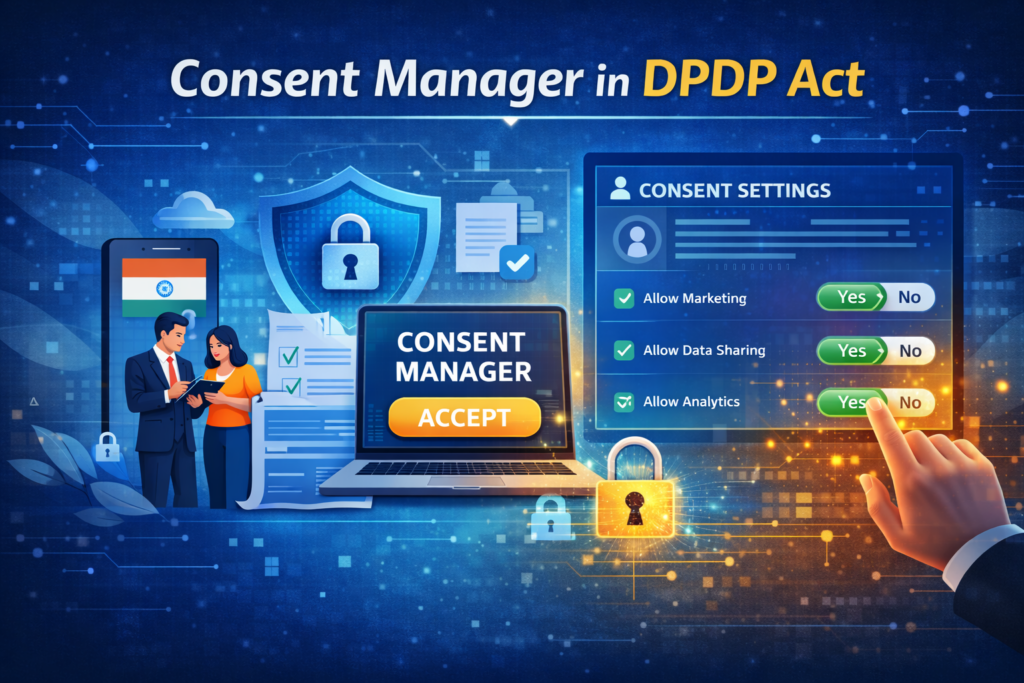
The consent manager in DPDP Act is one of the most important — and often misunderstood — elements of India’s Digital Personal Data Protection framework. A consent manager is a registered entity that acts as a trusted intermediary between individuals and organizations, enabling users to manage, grant, review, and withdraw consent for the processing of their personal data. For businesses navigating DPDP compliance, understanding what a consent manager does and how it works is essential.
To understand the consent manager’s role in context, start with our complete guide on what the DPDP Act is and why it matters for Indian businesses. For a deeper look at the compliance steps involved, read our guide on DPDP Act compliance steps every business must follow.
What is a Consent Manager in the DPDP Act?
A consent manager in the DPDP Act is an officially registered entity that provides a platform for individuals to control how their personal data is used. It operates as a standardized consent handling system that organizations integrate with to ensure compliance. Consent managers simplify the process of managing permissions across multiple platforms while giving users complete visibility and control over their data.
- Registered Entity: Must be officially recognized under DPDP regulations to operate legally
- Consent Platform: Provides an interface for users to manage data permissions efficiently
- Standardization: Ensures consistent consent handling across different organizations and systems
- Integration Capability: Works with multiple platforms to manage consent centrally
- User Empowerment: Gives individuals complete control over personal data sharing decisions
- Operational Efficiency: Simplifies consent management for organizations handling large volumes of data
Role of the Consent Manager in Data Privacy
The consent manager plays a critical role in ensuring data privacy by enabling transparent, accountable consent handling. It ensures users are informed about how their data is used and can make active decisions about their permissions. Understanding the broader landscape of what data privacy and protection means for businesses helps frame the consent manager’s importance in any DPDP compliance strategy.
- Transparency Enforcement: Ensures users clearly understand how their data is being used
- Consent Tracking: Maintains secure records of all consent provided by individuals
- User Awareness: Educates users about their data rights and usage practices
- Privacy Protection: Prevents unauthorized data usage through controlled consent mechanisms
- Regulatory Alignment: Ensures compliance with DPDP privacy requirements consistently
- Data Control: Empowers individuals to manage their personal data effectively
Key Functions of a Consent Manager
Consent managers perform multiple functions across the entire consent lifecycle — from initial collection through to withdrawal and deletion. These functions make them indispensable for organizations serious about DPDP compliance.
- Consent Collection: Enables users to provide consent for specific data processing activities
- Consent Storage: Maintains secure, auditable records of all consent for compliance purposes
- Consent Withdrawal: Allows users to revoke consent at any time without complications or delays
- Consent Update: Enables modification of permissions based on evolving user preferences
- Audit Trail: Maintains complete history of consent actions for transparency and accountability
- Access Interface: Provides an easy-to-use platform for managing data permissions
Consent Manager vs Data Fiduciary: Key Differences
It is important to distinguish between a consent manager and a data fiduciary, as both have distinct roles under the DPDP Act. While they must work together to ensure lawful and secure data usage, their responsibilities are fundamentally different.
| Aspect | Consent Manager | Data Fiduciary |
|---|---|---|
| Primary Role | Manages user consent and permissions | Processes and stores personal data |
| User Interaction | Directly interfaces with individuals for consent management | Interacts with data for processing and analysis |
| Data Handling | Handles only consent records, not personal data | Handles actual personal data processing and storage |
| Compliance Role | Ensures consent is valid, informed, and revocable | Ensures lawful processing based on valid consent |
| Registration | Must be registered under DPDP regulations | Must comply with DPDP as data processor |
| Accountability | Accountable for consent management practices | Accountable for data processing and security |
Consent Lifecycle Management
Consent managers handle the complete lifecycle of consent — from the moment a user first grants permission through to final withdrawal or expiry. This end-to-end lifecycle management is what makes them so valuable for DPDP compliance.
- Consent Initiation: Begins when users provide clear permission for data processing activities
- Consent Validation: Ensures consent is valid, informed, and compliant with legal requirements
- Consent Storage: Maintains records securely for future reference and audit purposes
- Consent Monitoring: Tracks ongoing data usage based on current permissions continuously
- Consent Withdrawal: Allows users to revoke consent easily at any stage
- Consent Expiry: Ensures outdated consent is flagged, removed, and refreshed when required
Importance of Consent Managers for DPDP Compliance
For organizations working toward full DPDP Act compliance, consent managers are one of the most practical tools available. They reduce the complexity of managing consent at scale, maintain audit-ready records, and demonstrate a genuine commitment to data principal rights — all of which matter significantly to regulators.
- Compliance Enablement: Helps organizations meet DPDP consent requirements effectively
- User Trust: Builds confidence by giving users meaningful control over their data
- Operational Efficiency: Reduces manual effort in managing consent across multiple systems
- Risk Mitigation: Prevents unauthorized data processing and reduces compliance exposure
- Audit Readiness: Maintains structured records for regulatory audits and verification
- Scalability: Supports large-scale data operations with efficient consent management
Technology Behind Consent Managers
Consent managers rely on advanced technology to operate securely and efficiently at scale. Integration with broader IT security infrastructure is critical — our Information Security (InfoSec) services help organizations ensure that the systems surrounding consent management are robust and properly secured.
- API Integration: Enables seamless connection with multiple platforms for real-time consent management
- Encryption: Protects all consent data from unauthorized access and security threats
- User Dashboard: Provides a clear interface for users to manage and review their consent
- Data Logs: Maintains detailed, timestamped records of all consent actions for audits
- Automation: Reduces manual effort in tracking and updating consent dynamically
- Security Framework: Ensures protection of consent-related data across all systems
Regulatory Requirements for Consent Managers
Consent managers must comply with strict regulatory requirements under the DPDP Act. These requirements ensure that consent managers operate with the same standards of transparency, security, and accountability expected of all DPDP-regulated entities. Businesses should also ensure their underlying IT infrastructure meets CERT-In cybersecurity compliance requirements, which complement DPDP consent obligations.
- Registration Requirement: Must be registered with the appropriate authority to operate legally
- Transparency Mandate: Must provide clear information on how consent is managed and used
- Security Standards: Must implement strong security measures to protect all consent data
- User Rights Support: Must enable users to exercise their full rights over personal data
- Audit Compliance: Must maintain records for regulatory audits and compliance verification
- Accountability Measures: Must demonstrate responsibility for managing consent securely
Benefits of Consent Managers for Organizations
Beyond regulatory compliance, consent managers deliver real operational and strategic benefits for organizations of all sizes. When combined with IT audit and compliance support, they provide a comprehensive foundation for demonstrating accountability to both regulators and customers.
- Compliance Assurance: Ensures adherence to DPDP consent requirements consistently
- Process Simplification: Reduces complexity in managing user permissions across systems
- Risk Reduction: Minimizes risk of non-compliance and data misuse incidents
- Audit Readiness: Maintains structured records for regulatory checks at any time
- Scalability Support: Handles large volumes of consent efficiently across platforms
- Cost Efficiency: Reduces manual effort and operational costs associated with compliance
Benefits of Consent Managers for Individuals
Consent managers are not just a compliance tool — they genuinely empower individuals to exercise meaningful control over their personal data in the digital ecosystem.
- Data Control: Enables individuals to manage how their data is used across organizations
- Transparency: Provides clear visibility into data usage practices
- Ease of Use: Simplifies consent management through a centralized platform interface
- Privacy Protection: Prevents misuse of personal data through controlled permissions
- Flexibility: Allows users to modify or withdraw consent at any time conveniently
- Trust Enhancement: Builds confidence in digital services through secure, accountable data practices
Consent Manager and Cybersecurity Integration
Consent managers must integrate tightly with cybersecurity systems to ensure that consent data itself is protected from threats. Remote Monitoring and Management (RMM) services provide the continuous visibility needed to detect unauthorized activities targeting consent systems. Keeping systems updated through patch management services closes the vulnerabilities that cybercriminals exploit to compromise consent infrastructure.
- Security Integration: Works with cybersecurity tools to protect consent-related data
- Access Controls: Restricts access to consent data based on defined roles securely
- Monitoring Systems: Detects unauthorized activities related to consent management proactively
- Incident Response: Ensures quick action during security incidents affecting consent systems
- Data Encryption: Protects consent records during storage and transmission
- Compliance Alignment: Ensures integration meets both DPDP and cybersecurity requirements
Challenges in Implementing Consent Managers
While consent managers offer significant benefits, implementation comes with real challenges that organizations must plan for carefully. Understanding how to handle security incidents in regulated environments is particularly relevant for organizations deploying consent management systems for the first time.
- Integration Complexity: Connecting multiple systems for centralized consent management can be challenging
- User Awareness: Lack of awareness may limit effective adoption of consent management tools
- Cost Factors: Implementation requires investment in technology and infrastructure
- Data Synchronization: Ensuring consent consistency across systems can be difficult at scale
- Security Risks: Protecting consent data from cyber threats requires robust measures
- Regulatory Changes: Evolving laws may require continuous updates to consent systems
Best Practices for Using Consent Managers
Organizations that follow best practices for consent manager implementation maximize both compliance outcomes and user trust. The role of the Data Protection Officer (DPO) in cybersecurity governance is particularly relevant here — DPOs often own the consent management strategy and must ensure it is properly implemented and maintained.
- Clear Policies: Define clear guidelines for consent management and data handling practices
- User-Friendly Design: Ensure consent platforms are intuitive for better adoption and engagement
- Regular Audits: Conduct audits to ensure compliance and identify gaps continuously
- Security Measures: Implement strong controls to protect consent data from threats
- Employee Training: Educate staff on proper use of consent management systems
- Continuous Monitoring: Track system performance and maintain DPDP compliance regularly
Future of Consent Managers in the DPDP Ecosystem
Consent managers will become increasingly central to India’s data privacy landscape as the DPDP Act matures and enforcement strengthens. Organizations that implement consent management systems early will be far better positioned to adapt to future regulatory changes. Understanding how continuous IT governance protects organizations long-term provides a useful model for sustainable consent management as the regulatory environment evolves.
- Adoption Growth: Increasing use of consent managers across industries for compliance
- Technology Evolution: Advanced tools will improve efficiency and user experience significantly
- Regulatory Expansion: Future laws may introduce stricter requirements for consent systems
- User Awareness: Individuals becoming more aware of data rights and control mechanisms
- Automation Integration: Automated systems will streamline consent management processes
- Global Influence: Similar consent manager frameworks may be adopted globally
How Infodot Supports Consent Manager Implementation
Infodot helps organizations design, integrate, and operate consent manager systems that are fully aligned with DPDP Act requirements. From compliance consulting and security implementation to continuous monitoring and audit support, our managed IT support services ensure your consent management infrastructure is secure, scalable, and regulatory-ready from day one.
- Compliance Consulting: Designs consent management frameworks aligned with DPDP regulations
- Technology Integration: Integrates consent systems with your existing IT infrastructure seamlessly
- Security Implementation: Protects consent data through advanced cybersecurity controls
- Monitoring Services: Provides continuous monitoring to detect risks and ensure compliance
- Audit Support: Prepares organizations for regulatory audits and compliance verification
- Operational Support: Ensures smooth functioning of consent management systems over time
Conclusion
The consent manager in the DPDP Act is far more than a compliance checkbox — it is a fundamental mechanism for building genuine trust between organizations and individuals in India’s digital economy. By providing transparency, enabling meaningful user control, and maintaining accountable records, consent managers help businesses demonstrate real commitment to data privacy. Organizations that implement consent management systems proactively will be better placed for regulatory compliance, reduced risk, and long-term customer trust.
FAQs — Consent Manager in DPDP Act
What is a consent manager in the DPDP Act?
A consent manager in the DPDP Act is a registered entity that acts as a trusted intermediary between individuals and organizations, enabling users to manage, grant, review, and withdraw consent for the processing of their personal data in compliance with the Digital Personal Data Protection Act.
Why is a consent manager important under DPDP?
Consent managers are important because they simplify consent handling, ensure organizations comply with DPDP rules, and empower users by giving them meaningful control over how their personal data is used across digital platforms.
Who can act as a consent manager?
Any entity that meets regulatory requirements and is officially registered under the DPDP Act can act as a consent manager. It must ensure secure, transparent, and fully compliant consent management practices at all times.
How does a consent manager work?
A consent manager provides a platform where users can grant, review, or withdraw consent for specific data processing purposes. It connects with organizations through APIs to manage permissions in real time and ensures data is processed only as per current user approval.
Can users withdraw consent anytime through a consent manager?
Yes, users can withdraw consent at any time through the consent manager platform. Once withdrawn, the organization must stop processing the user’s data unless there is another valid legal basis, ensuring full compliance with DPDP requirements.
What is the difference between a consent manager and a data fiduciary?
A consent manager manages user consent and permissions but does not process personal data itself. A data fiduciary is the entity that processes and stores personal data. Both must work together to ensure lawful data usage under the DPDP Act.
Are consent managers mandatory under the DPDP Act?
Consent managers are not mandatory for all organizations, but they provide a standardized and efficient way to manage consent at scale, making DPDP compliance significantly easier and more reliable for businesses handling large volumes of personal data.
What security measures do consent managers use?
Consent managers use encryption, access controls, multi-factor authentication, and real-time monitoring systems to protect consent records and prevent unauthorized access or tampering with consent data.
Can one consent manager work with multiple organizations?
Yes, a consent manager can integrate with multiple organizations and platforms simultaneously. This allows users to manage all their consents in one centralized place, improving convenience, visibility, and control over personal data usage.
What is the future of consent managers in India?
Consent managers will become increasingly central to India’s data privacy framework as the DPDP Act matures. They will play a growing role in ensuring compliance, strengthening user trust, and driving accountability across India’s expanding digital ecosystem.